I used the previous drawing of the elephant head that I drew on my iPad as a preparatory drawing for this piece of work. I wanted to do a full composition of an elephant and complete it in colour and whilst I completed the drawing, I decided to take photos of the stages of completion so that you can see how I progressed with this piece of work.
The first stage involved drawing a grid in my sketchbook and then drawing the outline of the elephant:

As you can see, it’s a basic drawing, but at this stage, it was just a matter of getting the composition right before beginning the shading. The shape of the elephant was gradually altered as I progressed with the shading and you can see this in the different photos.
I began the shading by working on the left ear (as you look at the elephant):

The shading on the ear is slowly beginning to bring the elephant to life, but there is still a long way to go. At this stage of the shading, I was using two shades of grey, along with Derwent Precision 0.7mm HB mechanical pencil and an F pencil.
After shading the left ear, I moved on to the face and the trunk:
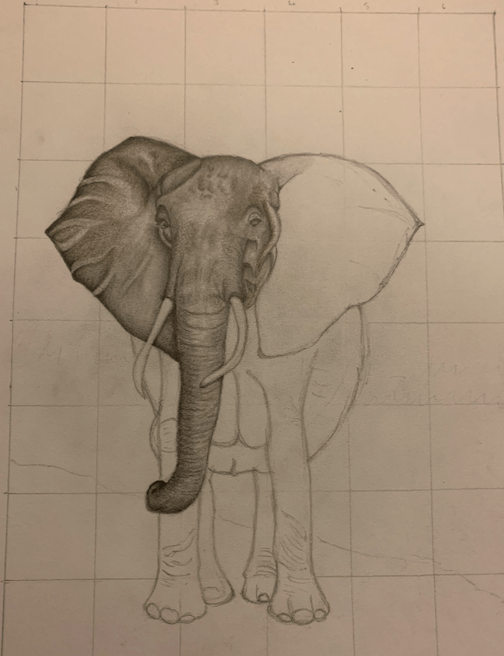
I felt at this stage that the elephant was really coming to life, and I was trying to get as much texture into the elephant’s head as possible. I noticed from the photo that I was using that the elephant wasn’t just shades of grey, but it was also brown as well, so I introduced a brown colouring pencil into the shading process.
After shading in the face and the trunk, I moved on to the right ear:
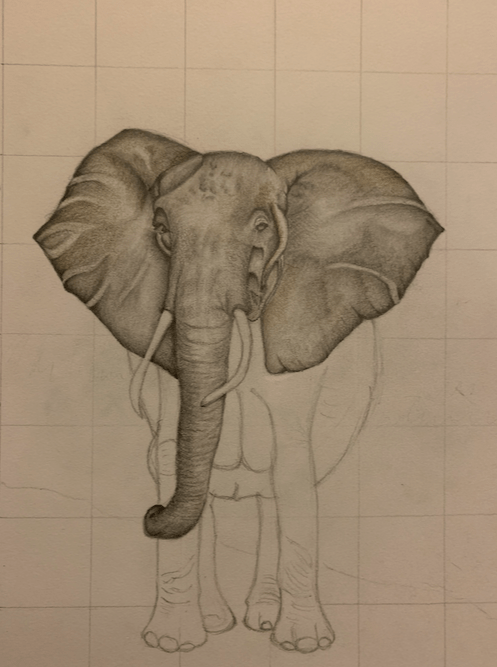
At this stage, I was feeling really pleased with how the elephant was progressing; it was beginning to feel even more life-like. I had to be mindful of the fact that there was going to be a lot of dark colours on the elephant and that I needed to ensure that I start each part of the elephant as light as possible and then build the layers up. Whilst carrying out the shading of the face and the trunk, I found that I was having to constantly re-draw the shape of the tusks, and that I needed to make sure there was the shadow of the tusks on the trunk.
After completing this stage of the elephant, it was time to move on to the legs:

You can see that I have completed a lot more of the elephant when you compare this image to the previous image. I wanted to ensure that there was enough shading around the tusk and the ear on the right-hand side to make the image more three-dimensional. I had also re-drawn the body on the right-hand side to make it less rounded as it didn’t look very proportionate when you compared it to the rest of the elephant.
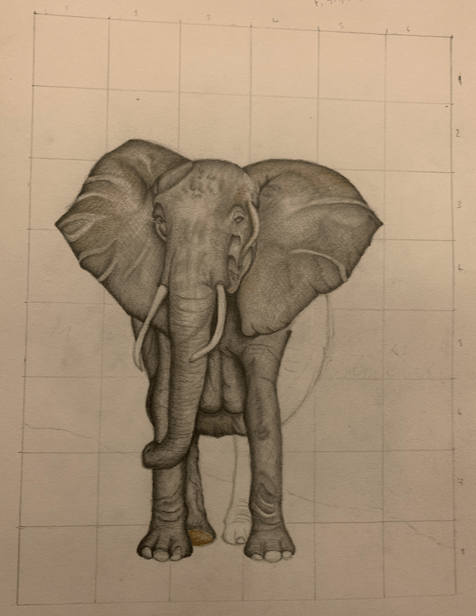
In this image, three of the legs have now been completed, and the elephant is now growing on the page, and becoming more life-like. At this stage, I was trying to decide what to do with the background once I had completed the shading on the elephant. Backgrounds are not my forte, and at some point, I need to take my sketchbook out with my pencils and practice doing scenery.
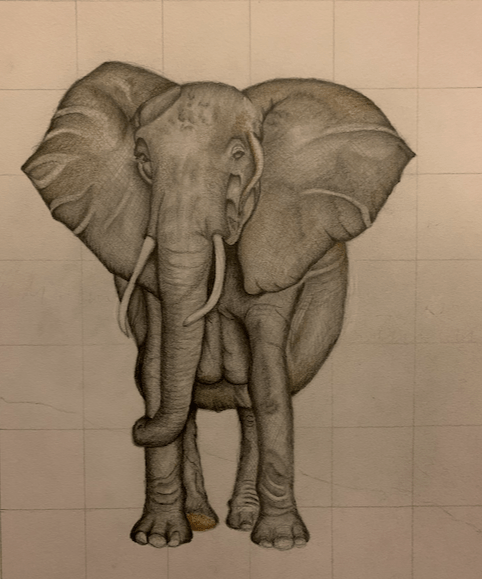
This is the finished image of the elephant. Surprisingly, I found the right-hand side of the body the most difficult to complete; I couldn’t get it to match the rest of the elephant, but after several attempts, I think I managed it. The next stage was to erase the grid and complete the background. This is the finished result:
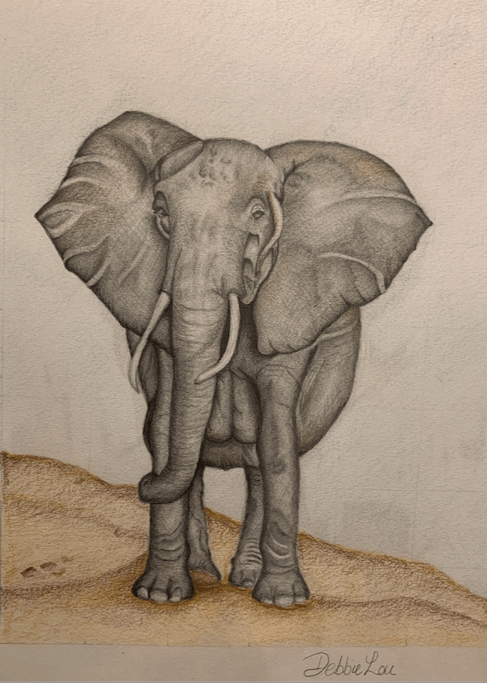
I’m please with the end result as I’ve never drawn an elephant before. There is room for improvement, for example, the markings on the ears could be less prominent. I think the elephant is in proportion and I am particularly pleased with how the face turned out. The background is ok, but I think it would be even better once I have learnt how to draw scenery, and this is something that I can work on. I may even invest in watercolour pencils and try working with alternative media.
 Genie Art